


Butterfly Rugs: The Pakistani Butterfly Bokhara
Last Update: June 2026
The Butterfly rug is not a separate weaving tradition. It is a variation of one of the most celebrated handmade rug designs in the world: the Pakistani Bokhara.
To understand the Butterfly rug you need to understand the Bokhara first. The Bokhara design takes its name from the ancient Silk Road city of Bukhara in present-day Uzbekistan, through which Turkoman tribal rugs were historically traded on their way to markets in Persia and Europe. The design itself originated with the Tekke tribe, a nomadic Turkoman people whose characteristic geometric motif, the gul, became the defining visual element of the entire Bokhara tradition. The gul, typically an octagonal medallion arranged in precise repeating rows across the field, is the signature of every Bokhara rug made anywhere in the world.
Pakistani weavers adopted the Bokhara design in the mid-20th century and refined it into one of the finest expressions of the tradition. Using a combination of New Zealand worsted wool and high-quality local Pakistani wool on a cotton foundation, Pakistani Bokharas became celebrated for their extraordinarily soft, thick pile, crisp geometric clarity, and availability in a wide range of jewel tones far beyond the traditional deep red of Central Asian Bokhara production.

The Butterfly Bokhara is a specific variation of this Pakistani tradition. The traditional octagonal gul is replaced with a modified butterfly-shaped motif, a more open, diamond-like form that creates a lighter, more delicate visual effect across the field while retaining the same systematic repeating row composition of the classic Bokhara design. The result is a rug that shares the structural logic and visual rhythm of the traditional Bokhara but with a softer, more graceful character that appeals to buyers who want the Bokhara aesthetic without the visual density of the standard gul.
Design and Composition
The Butterfly motif sits at the center of each repeating unit across the field, surrounded by smaller geometric secondary motifs and framed by the multiple-border structure characteristic of all Bokhara rugs. Like the standard Bokhara, the composition is based on precise rows and columns of the repeated central motif, creating a satisfying visual rhythm that reads coherently from any angle and at any scale from a small accent rug to a large room-size piece.
The border treatment follows the traditional Bokhara format with an inner guard border, a main border featuring geometric repeating elements, and an outer guard border. This layered border structure is one of the hallmarks of quality Pakistani Bokhara production and gives the rug a finished, formal character that suits both traditional and contemporary interiors.
Because the Butterfly motif is more open than the standard octagonal gul, the field of a Butterfly Bokhara often has a slightly airier, less dense visual quality than a traditional Bokhara. This makes it particularly well suited to rooms where the boldness of the standard Bokhara design might feel too heavy or where a lighter geometric pattern is preferred.
Materials and Construction
Pakistani Butterfly Bokharas are hand-knotted using a combination of New Zealand worsted wool and quality Pakistani wool on a cotton foundation. New Zealand worsted wool is the premium choice for Pakistani Bokhara production because of its exceptional softness, consistent fiber length, and natural sheen. The cotton foundation provides dimensional stability, keeping the rug flat and preventing distortion over time.
The pile is typically plush and thick, clipped to a consistent height that gives the surface its characteristic velvety feel. This thick, soft pile is one of the defining sensory qualities of the Pakistani Bokhara tradition and one of the primary reasons buyers return to it repeatedly. Few hand-knotted rugs of any tradition feel as luxurious underfoot.
The knot used is the symmetrical Ghiordes knot, the same knot used throughout Pakistani Bokhara production. Knot density in Butterfly Bokhara rugs typically ranges from around 120 to 160 knots per square inch, somewhat lower than the finest Pakistani Bokharas which reach 200 to 300 KPSI. This difference in knot density gives the Butterfly Bokhara its characteristic slightly broader motif scale and the soft, slightly relaxed character that distinguishes it from the tighter, more precise standard Bokhara.
Color
One of the great strengths of Pakistani Butterfly Bokharas is their availability in a wide range of colors far beyond the traditional red of Central Asian Bokhara production. While deep red and burgundy remain the most classic choices, Pakistani weavers produce Butterfly Bokharas in navy, forest green, teal, ivory, camel, gold, and black, all using high-quality colorfast synthetic dyes that maintain their vibrancy over decades of use.
This color range makes the Butterfly Bokhara an unusually versatile handmade rug for interior design purposes. A navy Butterfly Bokhara suits a contemporary bedroom with cool-toned furniture. A teal or green version works in living rooms where color is wanted without the traditional red. An ivory version in a smaller size suits a bedroom or study where warmth without strong color is the priority.

The Butterfly Bokhara in Your Home
The Butterfly Bokhara works in the same spaces as the standard Bokhara. Living rooms, dining rooms, bedrooms, and studies all suit the formal geometric character of the design. The thick soft pile makes it genuinely comfortable underfoot in a bedroom. The rich jewel-toned palette and systematic repeating composition give it the visual authority to anchor a living room or dining room.
Because the Butterfly motif is slightly lighter and more open than the standard gul, the Butterfly Bokhara can work in rooms where the full visual density of a standard Bokhara might feel overwhelming. It offers the structure and elegance of the Bokhara tradition with a somewhat softer presence.
For a living room in traditional or transitional style, a 9x12 Butterfly Bokhara in deep red or navy creates an immediate sense of settled elegance. For a bedroom a 5x8 or 6x9 in ivory or camel brings warmth and pattern without visual competition with the rest of the room. For a hallway or staircase a Butterfly Bokhara runner in any color provides the durability and visual interest that high-traffic spaces require.
Browse our full collection of Bokhara rugs including standard Bokhara and Butterfly Bokhara variations in all sizes. For related Pakistani weaving traditions see our Pakistani rugs collection. Free worldwide shipping on every order from ALRUG, sourcing directly from weavers in Pakistan and Afghanistan since 1952.
Frequently Asked Questions
What is a Butterfly rug? A Butterfly rug, also called a Butterfly Bokhara, is a hand-knotted Pakistani rug that uses a modified butterfly-shaped motif instead of the traditional octagonal gul of the standard Bokhara design. The overall composition, systematic repeating rows of the central motif framed by multiple borders, follows the classic Bokhara format. The butterfly motif gives the design a slightly more open, lighter character compared to the standard gul.
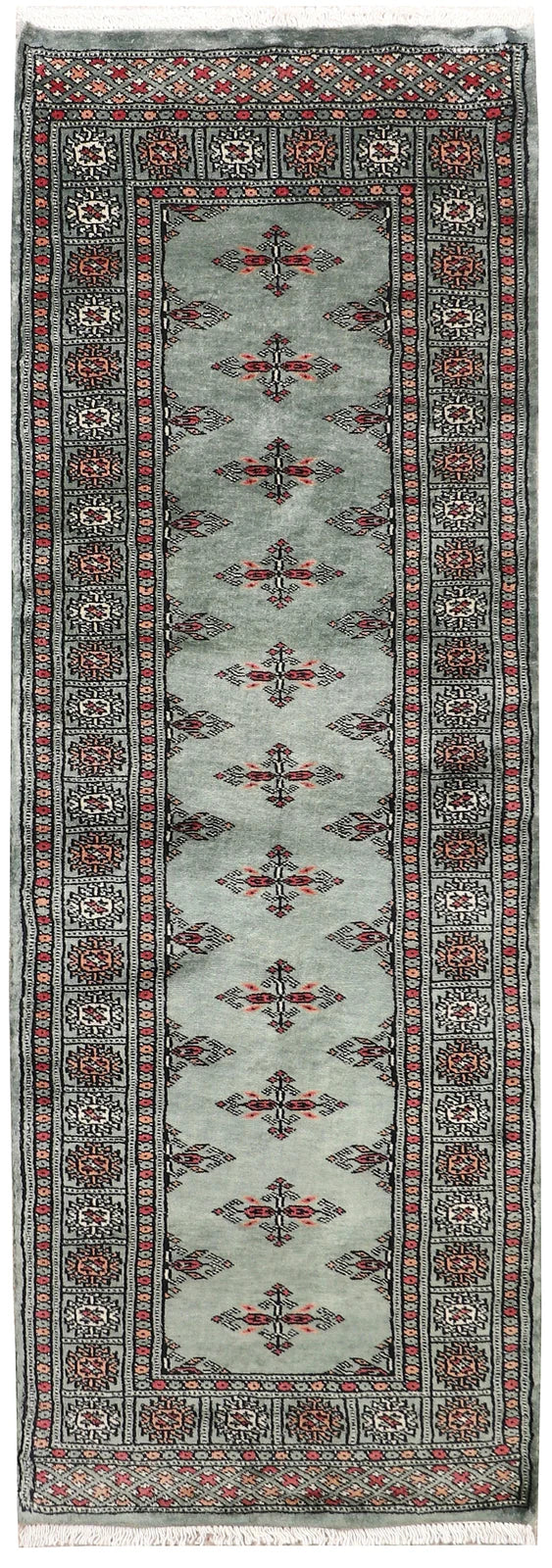
How is a Butterfly rug different from a standard Bokhara? The key difference is the central repeating motif. A standard Bokhara uses the traditional Tekke gul, typically an octagonal medallion that creates a dense, formally geometric composition. A Butterfly Bokhara replaces this with a butterfly-shaped motif that is more open and diamond-like, giving the rug a slightly lighter visual quality while maintaining the same systematic repeating row structure. The knot density of Butterfly Bokharas is typically somewhat lower than the finest standard Bokharas, contributing to the slightly softer, more relaxed character of the design.
Where are Butterfly Bokharas made? Butterfly Bokharas are made in Pakistan, primarily in the weaving centers of Lahore, Rawalpindi, and Karachi. They use a combination of New Zealand worsted wool and quality Pakistani wool on a cotton foundation, the same materials used in standard Pakistani Bokhara production.
What colors are Butterfly Bokharas available in? Butterfly Bokharas are available in a wide range of colors including deep red, burgundy, navy, forest green, teal, ivory, camel, gold, and black. This color range is one of the distinctive strengths of Pakistani Bokhara production generally and makes the Butterfly Bokhara unusually versatile for interior design.
Are Butterfly Bokharas good quality? Yes. Pakistani Butterfly Bokharas are hand-knotted using quality wool on a cotton foundation, the same construction as all Pakistani Bokhara production. The thick soft pile and colorfast synthetic dyes produce a durable, luxurious rug that will maintain its appearance and structural integrity for decades with proper care.
How do I care for a Butterfly Bokhara rug? Vacuum regularly on low suction without a beater bar. Rotate every six months for even wear. Address spills immediately by blotting with a clean dry cloth, never rubbing. Use a quality rug pad underneath. Have professionally cleaned every two to three years by a specialist in handmade Oriental rugs.