


Bokhara Rugs: The Definitive Guide
Last Updated: June 2026
There is a rug pattern so recognizable that people who have never bought a rug in their lives can identify it on sight. Rows of geometric medallions, a rich red ground, precise geometric borders. The Bokhara. It appears in living rooms from London to Los Angeles, in grand country houses and city apartments, in decorator showrooms and estate sales. It has been woven for centuries by Turkmen tribal weavers in Central Asia and is now produced at scale in Pakistan and Afghanistan by the descendants of those same weaving traditions. It is the most widely collected hand-knotted rug type in the Western world.
And yet most people who own a Bokhara rug know almost nothing about what it actually is, where it comes from, why the gul looks the way it does, or what separates a fine example from a mediocre one.
This guide covers all of it. By the end you will understand the complete history of Bokhara rugs, know the difference between a Tekke gul and a Yomut gul, be able to distinguish Pakistani from Afghan production, know exactly what to look for when buying, and understand why the rug on your floor may be worth considerably more than anyone realized.
The Name and Its History
The name Bokhara requires immediate clarification because it is used in a way that confuses nearly everyone who encounters it for the first time.
Bokhara - also spelled Bukhara - is an ancient city in what is now Uzbekistan. It sits in the Zerafshan Valley in the heart of Central Asia and was for over a millennium one of the great cities of the Islamic world. As a major stopping point on the Silk Road trade routes, Bukhara became fabulously wealthy. Merchants from China, Persia, India, and the Ottoman Empire converged on its markets. Textiles - including carpets and rugs from the surrounding Turkmen tribal territories - were among the most important commodities traded there. Western buyers who encountered these rugs in Bukhara's markets named them after the city, and the name stuck.
The rugs themselves were not made in Bukhara. They were made by Turkmen tribal peoples who lived in the vast steppes and deserts surrounding the city - nomadic and semi-nomadic groups including the Tekke, the Yomut, the Salor, the Ersari, and others whose weaving traditions had developed over many centuries independently of any urban center. Bukhara was simply where their rugs entered the wider world's consciousness.
This distinction matters because it explains why there is no single Bokhara weaving tradition. The name covers a design family - rugs featuring the distinctive gul medallion pattern - that was produced by multiple different tribes, each with its own variant of the gul, its own color preferences, and its own construction characteristics. Understanding Bokhara rugs means understanding the Turkmen tribal tradition that produced them.
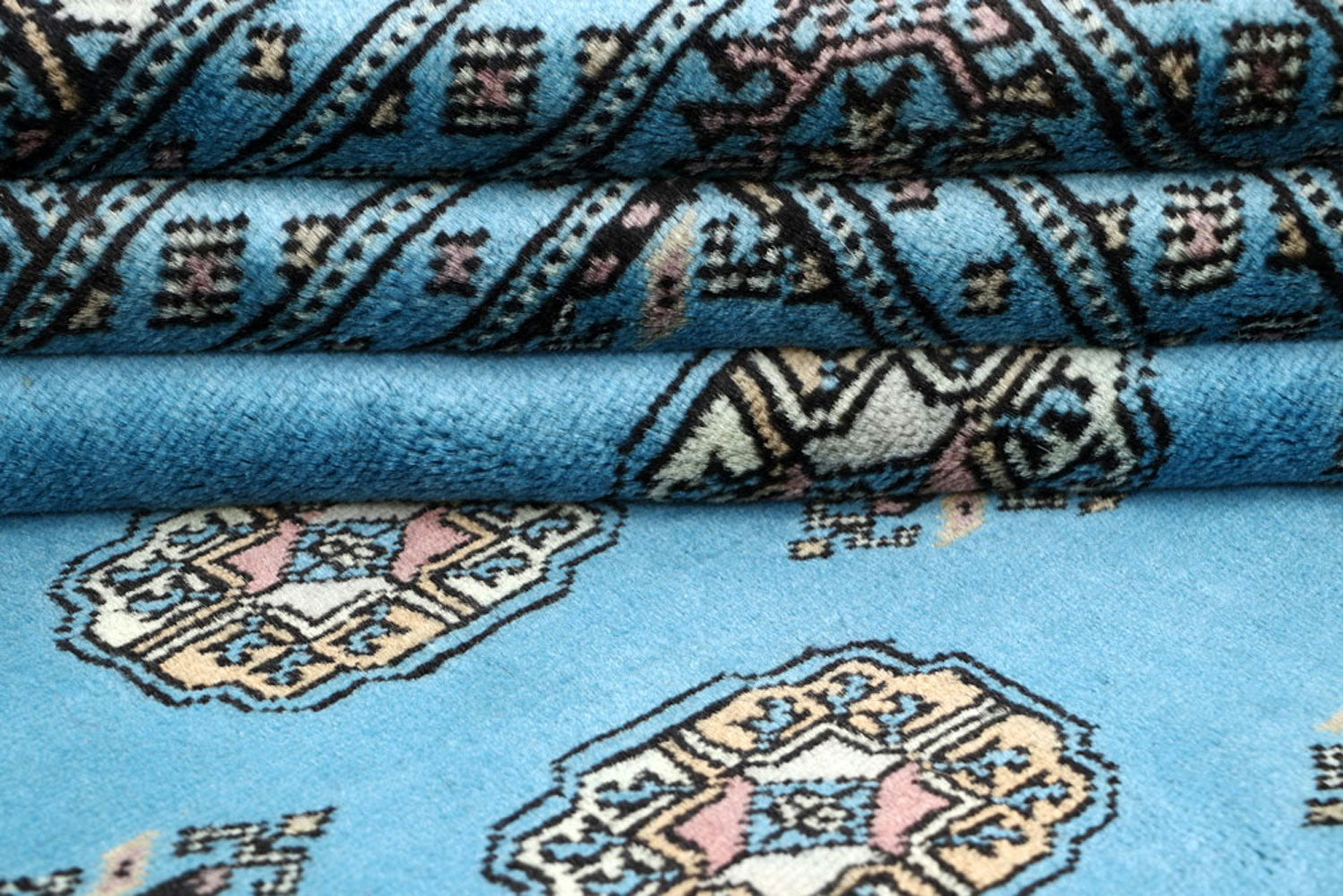
The Silk Road Context
To understand why Bokhara rugs became so significant you need to understand the role of Bukhara in the medieval Islamic world. By the 9th century, during the Samanid dynasty, Bukhara was the capital of a civilization that rivaled anything in the contemporary world for learning, culture, and material sophistication. The philosopher and physician Ibn Sina - known in the West as Avicenna - was born near Bukhara in 980 CE. The city's libraries, mosques, and markets were famous across the Islamic world.
The Silk Road trade that flowed through Bukhara brought extraordinary material wealth and cultural exchange. Textiles were at the heart of this trade - silk from China, cotton from India, wool goods from the steppe - and the Turkmen tribes whose territories surrounded Bukhara were among the most skilled textile producers in the region. Their hand-knotted pile rugs, featuring the distinctive gul patterns that would eventually become known as Bokhara, were prized across the trading world.
By the time Western collectors and dealers began engaging seriously with oriental rugs in the 18th and 19th centuries, Bukhara was still the primary market through which Turkmen rugs reached the West. The commercial name became the design name, and the association has persisted ever since.
Today the vast majority of new Bokhara rugs are woven in Pakistan, primarily in the workshops of the Peshawar Valley and in the weaving communities of Punjab, by weavers whose families have maintained the Turkmen design tradition across generations of displacement and migration. Afghan weavers also produce Bokhara-format rugs, particularly in the northern provinces with strong Turkmen heritage.
The Gul: Tribal Identity Encoded in Wool
The gul is the defining design element of every Bokhara rug. The word means flower or rose in Persian and Turkic languages, though the forms used in Bokhara rugs are entirely geometric - no gul in the Turkmen tradition looks anything like a flower in the naturalistic sense. The name reflects the cultural importance of the form rather than its visual appearance.
In the traditional Turkmen weaving culture, the gul was a tribal identifier with a function similar to a heraldic device. Each major tribe had its own distinctive gul design that was considered the exclusive property of that tribe. A weaver's gul identified her tribe of origin as clearly as any flag or emblem. The practice of using a specific gul was governed by tribal custom and the unauthorized use of another tribe's gul was considered a serious cultural transgression.
This tribal heraldic function is why rug scholars can often identify the tribal origin of an antique Turkmen piece from its gul alone. The major gul types are well-documented and each has a specific tribal association.
The Tekke gul is the most widely recognized and most widely reproduced. It is associated with the Tekke tribe, historically the most powerful and commercially significant of the Turkmen groups, whose territories centered on the Mary oasis in present-day Turkmenistan. The classic Tekke gul is a roughly octagonal form divided into four quadrants with distinctive internal patterning, surrounded by a secondary minor gul - called the chemche gul - that fills the spaces between the primary guls across the field. This is the format most Western buyers visualize when they think of a Bokhara rug, and most commercially produced Bokhara rugs today use a version of the Tekke gul.
The Yomut gul, associated with the Yomut tribe of northwestern Turkmenistan and northeastern Iran, takes a more angular, diamond-like form than the Tekke octagonal. Yomut pieces are generally less commercially produced than Tekke-format rugs and tend to be more collected as genuine tribal pieces.
The Salor gul, associated with the Salor tribe who were historically the most prestigious of the Turkmen groups, is a particularly fine and complex form. Genuine antique Salor pieces are among the most valuable Turkmen tribal rugs in existence and rarely appear on the commercial market.
The Ersari tradition, associated with the Ersari tribal confederation of northern Afghanistan, uses a wider range of gul forms including the larger Khal Mohammadi gul that gives Khal Mohammadi rugs their distinctive character. The Ersari tradition is the most design-diverse of the major Turkmen groups and produced some of the most visually complex pieces in the broader Bokhara family.
The Bokhara Family: Understanding the Different Types
When you encounter a rug described as a Bokhara today, it is almost certainly one of several distinct types that fall under the broad commercial name.
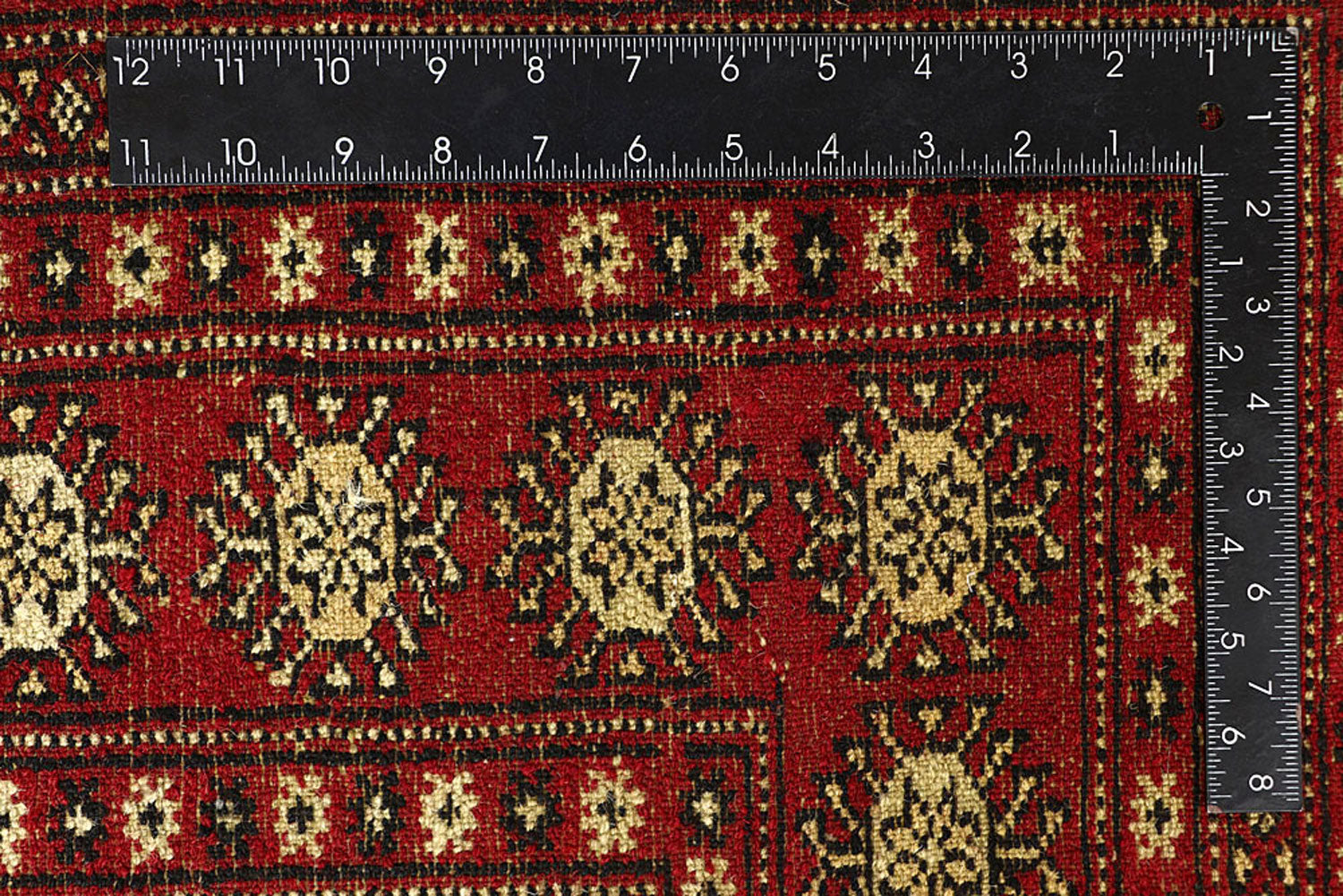
Antique Turkmen Bokharas are the original form - pieces produced by the Tekke, Yomut, Salor, Ersari, and other Turkmen tribes in the 19th and early 20th centuries, using natural vegetable dyes and hand-spun wool from tribal flocks. These are collector pieces found at specialist auction houses rather than in general commercial stock.
Pakistani Bokharas represent the large-scale commercial production that made the Bokhara format accessible to Western buyers from the mid-20th century onward. Pakistani Bokhara rugs are hand-knotted in the weaving workshops of Peshawar, Lahore, and Punjab by weavers from Afghan and Turkmen backgrounds. The quality range is broad - from basic commercial pieces to exceptional fine production that approaches antique quality in construction standards.
Afghan Bokharas are produced in the weaving communities of northern Afghanistan, primarily by Turkmen and Ersari weavers maintaining their tribal design traditions in a commercial production context. Afghan Bokharas tend toward slightly bolder, more geometric gul formats than Pakistani production and are often associated with higher-quality wool and more natural dye use. Khal Mohammadi rugs are the finest expression of this tradition. Jaldar rugs introduce greater complexity into the gul layout with denser secondary patterning.
Princess Bokharas is a term used in the trade for smaller, finer Bokhara pieces with a higher knot density than standard commercial production. The name has no tribal or historical basis - it is a commercial designation for quality tier.
Bokhara-style machine-made rugs are machine-produced rugs that copy the visual appearance of Bokhara gul patterning. They look similar to genuine hand-knotted Bokharas in photographs and are widely misrepresented as handmade. The tests for distinguishing genuine hand-knotted from machine-made production are covered below.
Color: The Bokhara Palette in Depth
Color is one of the most immediately distinctive aspects of any Bokhara rug and one of the most important factors in evaluating quality and authenticity.
The classic and most traditional Bokhara colorway is built around a deep madder red ground. This is not the bright synthetic red of fast fashion or cheap commercial production - it is a complex, deep tone achieved through the repeated dyeing of wool with madder root, a plant-based dye that has been used in Central Asian textile production for thousands of years. Natural madder red has a warmth and depth that shifts subtly as the light changes, appearing darker and more burgundy in shadow and warmer and more rust-toned in direct light. Synthetic red is flat, uniform, and slightly harsh by comparison.
Against this red ground, the gul patterning is typically carried in deep navy - from indigo dyeing - with secondary detailing in ivory from undyed or minimally processed natural wool, and occasional accents in dark green, orange, or camel tones. This combination - the deep red ground, the structured navy gul, the ivory ground field of the gul interior - is the fundamental visual grammar of the Bokhara rug and has remained essentially unchanged across generations of production.
The navy blue ground Bokhara is the second traditional colorway, reversing the red and blue relationship with a deep indigo field and red and ivory gul patterning. Contemporary production has expanded the palette significantly - ivory and cream ground Bokharas, washed and abrash versions, and darker chocolate and charcoal grounds have all grown in popularity with buyers who want the Bokhara design vocabulary in palettes suited to contemporary interiors.
The quality of the dyes matters significantly. The finest pieces use natural vegetable dyes - madder for the reds, indigo for the blues, weld and other plants for the yellows and greens. Natural dye colors age gracefully - mellowing and deepening over decades rather than fading toward flatness. Most contemporary Bokhara production uses synthetic dyes, and while quality has improved considerably, the distinction remains visible in the finest pieces.
Construction and Quality
Bokhara rugs are hand-knotted on cotton foundations using wool pile. The knot used is typically the asymmetric Persian knot, which allows greater design flexibility and finer detail than the symmetric Turkish knot. Knot density in quality Bokhara rugs typically falls in the range of 80 to 160 knots per square inch. Fine Pakistani Bokhara production can reach 200 KPSI and above, producing pieces with exceptional pattern clarity and a pile that feels almost silk-like in its density.
The wool quality is one of the most important factors in evaluating a Bokhara rug. The finest Pakistani and Afghan Bokhara production uses highland wool from sheep breeds that produce a naturally lustrous, resilient fiber. This wool has a characteristic warm sheen visible even in ordinary light and a firm, springy feel underfoot. Quality Bokhara wool feels firm and slightly warm to the touch - not slippery like synthetic fiber or coarse like low-grade wool. Limp, soft, flat-feeling pile is often a sign of lower-grade wool.
Foundation quality matters for long-term structural stability. Quality Bokhara rugs use a tightly woven cotton warp and weft that lies flat and does not distort with humidity changes. A Bokhara that buckles, waves, or refuses to lie flat has a foundation problem that will not improve over time.
Finishing quality is visible in the evenness of the pile clipping, the straightness of the borders, and the integrity of the fringe. The fringe of a genuine hand-knotted Bokhara is the exposed warp threads of the foundation - they emerge from within the weave structure rather than being sewn or glued on.
How to Tell a Genuine Hand-Knotted Bokhara from a Fake
The Bokhara gul pattern is one of the most commonly replicated in machine production because its bold, simple geometry translates well to mechanical loom production. There is more machine-made Bokhara pattern production than almost any other oriental rug design.
The back test is definitive. Turn the rug over. On a genuine hand-knotted Bokhara you will see individual knots clearly visible in a dense grid pattern that mirrors the front design. On a machine-made rug the back shows a uniform woven or looped structure with no individual knots. On a hand-tufted piece the back is covered with a glued fabric or latex backing concealing the tufting canvas.
The fringe test is quick and reliable. On a genuine hand-knotted Bokhara the fringe emerges from within the weave structure with no seam or attachment point. On a machine-made rug the fringe is sewn or glued on separately and you can see the stitching or adhesive at the attachment line.
The pattern regularity test distinguishes human from mechanical production. Genuine hand-knotted guls show very slight irregularities - minor variations in the size and spacing of individual guls, slight deviations in what should be straight border lines. Machine-made guls are mathematically perfect - every gul identical, every line laser-straight.
For the complete authentication guide see our post on how to tell if a rug is handmade.
Bokhara Rugs in Interior Design
The enduring appeal of Bokhara rugs in Western interiors has less to do with fashion than with the fundamental qualities of the design - its visual clarity, its color warmth, its geometric precision, and its ability to work in a wide range of spaces without demanding that the room be built around it.
In a traditional or transitional living room, a red ground Bokhara in an 8x10 or 9x12 size provides the warm, anchoring foundation that a formal seating arrangement needs. Dark wood furniture, leather seating, brass or bronze accessories, and warm neutral walls all work naturally with the traditional Bokhara palette.
In a contemporary interior, a navy or ivory ground Bokhara provides geometric structure without the warmth of the red colorway, making it more compatible with cooler palettes and more architectural furniture. The gul pattern, when viewed abstractly, has a quality not unlike certain contemporary geometric textile designs, which is part of why Bokhara rugs continue to find buyers in thoroughly modern interiors.
A Bokhara runner rug in a hallway is one of the most classic and practically effective uses of the design - the repeating gul pattern scales beautifully to the long, narrow format and the dense wool construction handles hallway foot traffic extremely well.
For dining rooms, the dense construction and wool quality of a good Bokhara means it handles the chair movement and foot traffic of daily dining use better than more delicate rug types. Choose a size that extends at least 24 inches beyond the table on all sides to ensure chairs remain on the rug when pulled out.
Bokhara Rugs as Investments
The investment case for quality Bokhara rugs is straightforward. Genuine hand-knotted Bokhara rugs from quality production hold their value and appreciate over time in a way that no machine-made or hand-tufted alternative can match.
Antique Turkmen Bokhara pieces from the 19th and early 20th centuries have appreciated substantially over the past several decades and are now firmly in collector territory. Fine antique Tekke main carpets with good natural dye color command serious prices at specialist auctions. Salor and early Yomut pieces are rarer and command even higher premiums.
For buyers at accessible price points, quality contemporary Pakistani and Afghan Bokhara production purchased at fair prices represents a long-term value proposition that machine-made alternatives cannot. A hand-knotted Bokhara rug will outlast its owner. A machine-made or hand-tufted alternative will not.
How to Choose a Bokhara Rug
When you are ready to buy, here is the evaluation sequence that will lead you to a quality piece.
Start with the back. Individual knots clearly visible in a pattern mirroring the front. Dense, even knot distribution. No fabric backing.
Assess the wool. Surface sheen visible in ordinary light. Firm, slightly warm feel. Resilience when pile is compressed and released.
Evaluate the red. Deep, warm, complex tone with natural variation in the pile. Not flat, not harsh, not orange-leaning.
Check gul sharpness. Clear, well-defined gul outlines with crisp color transitions between the red ground and the navy gul.
Confirm the fringe. Structural, emerging from the weave, no stitching or glue.
Check it lies flat. No buckling, no waves, lies flat on a hard floor without being weighted down.
ALRUG carries one of the largest collections of Bokhara rugs available online, sourced directly from weavers in Pakistan and Afghanistan with no middlemen. You can explore the full Bokhara rugs collection directly. Related styles worth comparing include Khal Mohammadi rugs, Jaldar rugs, Kazak rugs, Baluchi rugs, and the broader tribal rugs collection. For Afghan rugs and Pakistani rugs explore those collections directly.
Shop by size: 5x8, 8x10, 9x12, 10x14, runner rugs.
Shop by budget: under $499, $500-$999, $1000-$1499, $1500-$1999, $2000-$2999.
If you need a Bokhara in a specific size not available in our current stock, our custom rug service can produce any hand-knotted Bokhara design to your exact specifications. All orders include free worldwide shipping. For care and maintenance guidance see our complete rug care guide.
Frequently Asked Questions
What is a Bokhara rug? A Bokhara rug is a hand-knotted rug from the Turkmen weaving tradition of Central Asia, characterized by rows of repeating octagonal gul medallions on a typically red or navy ground. The name comes from the ancient Silk Road city of Bukhara in modern Uzbekistan, which was historically the major trading center for Turkmen tribal rugs. Most Bokhara rugs sold today are woven in Pakistan and Afghanistan by weavers maintaining the Turkmen design tradition.
What is the gul in a Bokhara rug? The gul is the central medallion motif repeated in structured rows across the field of a Bokhara rug. In the original Turkmen tribal tradition, each tribe had its own distinctive gul design that served as a tribal identifier - a heraldic symbol woven into every rug produced by that tribe. The most widely reproduced gul today is the Tekke gul, associated with the historically powerful Tekke tribe of Turkmenistan.
What is the difference between a Pakistani Bokhara and an Afghan Bokhara? Pakistani Bokharas are produced in the weaving workshops of Peshawar, Lahore, and Punjab and typically feature a dense, plush pile with the classic red ground and Tekke gul format developed specifically for Western markets. Afghan Bokharas are produced in northern Afghanistan primarily by Turkmen and Ersari weavers and tend toward slightly bolder, more geometric gul formats with often superior wool quality and more natural dye use. Khal Mohammadi rugs represent the finest Afghan Bokhara-family production.
How do I tell a genuine Bokhara from a machine-made copy? Turn the rug over. A genuine hand-knotted Bokhara shows individual knots in a dense pattern mirroring the front design. A machine-made copy shows a uniform mechanical backing with no individual knots. Also check the fringe - on a genuine hand-knotted Bokhara the fringe is the structural warp threads of the foundation, not sewn or glued on separately. For the complete authentication guide see our post on how to tell if a rug is handmade.
What size Bokhara rug should I buy for a living room? An 8x10 Bokhara suits most standard living rooms and is the most popular size for this rug type. A 9x12 is better for larger rooms or sectional sofa arrangements. For detailed sizing guidance see our living room rug size guide.
Are Bokhara rugs a good investment? Yes, provided you buy genuine hand-knotted production at fair prices. Quality hand-knotted Bokhara rugs hold their value and appreciate over time. Antique Turkmen Bokhara pieces from the 19th century command serious collector prices. Contemporary quality production from Pakistan and Afghanistan represents durable long-term value that machine-made alternatives cannot match.
What colors do Bokhara rugs come in? The most traditional colorway is a deep madder red ground with navy blue gul patterning in ivory and occasional green or orange accents. Navy blue ground versions are the second traditional colorway. Contemporary production also includes ivory and cream grounds, washed and faded palettes, and abrash effects across a wider color range. The traditional red ground remains the defining and most widely produced Bokhara colorway.
How long do Bokhara rugs last? A genuine hand-knotted Bokhara rug made from quality wool will last generations with proper care - typically 50 to 100 years or more. The dense hand-knotted construction is inherently durable and the wool pile develops a natural patina with age. Many Bokhara rugs purchased in the mid-20th century are still in daily use today.
What is the difference between a Bokhara and a Persian rug? Persian rugs come specifically from Iran and typically feature curvilinear floral and medallion designs from the great city weaving traditions of Tabriz, Kashan, and Isfahan. Bokhara rugs come from the Turkmen tribal tradition of Central Asia and are characterized by the bold geometric gul medallion format. Both are genuinely hand-knotted but they represent entirely different design traditions and regional origins. For more on this distinction see our post on oriental rugs history and culture.
How do I care for a Bokhara rug? Vacuum regularly using suction only without a beater bar. Rotate every six to twelve months. Blot spills immediately without rubbing. Use a quality rug pad underneath. For full care guidance see our complete rug care guide.