


Extra Long Runner Rugs: The Complete Sizing and Buying Guide
The most common runner rug mistake is not choosing the wrong pattern or the wrong color. It is choosing the wrong length. And for long hallways and grand staircases, the wrong length is almost always too short.
Standard runner lengths go up to 12 feet in most stores. Some retailers offer 16 and 20 feet. But a corridor of 25 feet, a staircase of 30 steps, or an open-plan pathway of 35 feet has no off-the-shelf solution in those ranges. You either piece together multiple runners and accept the seams, or you find a source that makes genuine extra long hand-knotted runners at the lengths you actually need.
This guide covers everything: how to measure correctly, what lengths are genuinely available in hand-knotted wool, how to calculate staircase runner length, and why a genuine hand-knotted extra long runner is a fundamentally different product from the synthetic alternatives that dominate most search results.

What Counts as an Extra Long Runner?
In the rug industry, a runner is any rug significantly longer than it is wide, typically with a width between 2 and 4 feet and a length starting at 6 feet. Standard lengths run from 6 to 12 feet. Extended or long runners go from 12 to 20 feet. Extra long runners begin at 20 feet and can extend to 30, 40, or even longer for custom orders.
The most common standard extra long runner lengths are 20 feet, 25 feet, and 30 feet. These cover the majority of grand hallway and staircase applications. Anything beyond 30 feet is typically a custom order even from specialist suppliers, though quality weaving workshops can produce lengths up to 40 feet in standard widths of 2'6" and 3'.
Width matters as much as length. For a hallway, the runner width should leave 4 to 6 inches of bare floor visible on each side. A corridor that is 4 feet wide calls for a runner no wider than 3 feet. A corridor of 5 feet suits a runner of 3 to 3'6". For staircases, the runner width should be 4 to 6 inches narrower than the stair tread width.
How to Measure for a Hallway Runner
Measuring a hallway runner is straightforward. You need two measurements: length and width.
For length: measure the full length of the corridor from wall to wall or from one doorframe to another. Subtract 8 to 12 inches from this measurement to determine your runner length. This leaves 4 to 6 inches of bare floor at each end, which is the standard interior design guideline for runner placement. A runner that runs wall to wall looks installed, not placed. A runner with a small margin of bare floor at each end looks intentional.
 For width: measure the full width of the corridor. Subtract 8 to 12 inches to leave 4 to 6 inches of bare floor on each side. In a corridor of 4 feet the ideal runner width is 2'6" to 3'. In a corridor of 5 feet a runner of 3' to 3'6" works well.
One practical note: if your hallway has doorways along its length, measure whether doors swing into the hallway. A thick-pile runner that extends across a doorway threshold may prevent the door from opening fully. Flatweave kilim runners with a lower profile are a practical solution for hallways with multiple doorways.
How to Measure for a Staircase Runner
Staircase runner measurement requires a simple calculation that most people find intuitive once they understand it.
Each step in a staircase consists of two surfaces: the tread, the horizontal surface you step on, and the riser, the vertical surface facing you as you ascend. A runner must cover both. To calculate the runner length you need, measure the tread depth and the riser height of a single step and add them together. Multiply that combined measurement by the number of steps. Add 12 to 18 inches for the landing at the top and the floor at the bottom.
For a standard staircase with a 10 inch tread and 7 inch riser, each step requires 17 inches of runner. For 20 steps: 20 x 17 inches = 340 inches = 28.3 feet. Round up to 30 feet to give yourself installation room. For 25 steps at the same dimensions: 25 x 17 = 425 inches = 35.4 feet. A 36 to 38 foot runner is appropriate.
Always measure your own staircase. Tread depths and riser heights vary considerably, and relying on standard assumptions for your calculation risks an expensive shortfall. If your calculation puts you between standard lengths, always choose the longer option. You can adjust the installation to manage extra length. You cannot add length that is not there.
Why Seamed Runners Are Not the Answer
The obvious workaround for a 28-foot hallway when standard runners only go to 12 or 16 feet is to seam two runners together. This approach has several problems that become apparent quickly.
The seam itself is always visible. Even with professional installation and careful color matching, two separate runners placed end to end show a line that the eye immediately picks up, particularly in a well-lit corridor. As the runners experience different levels of foot traffic and different amounts of light exposure, the color and pile wear at each end of the seam diverge over time, making the seam increasingly visible.
The transition between runners creates a trip hazard. Even a perfectly flat seam between two runners produces a subtle elevation change that catches feet, particularly in low-light conditions. This is a practical safety concern in hallways used daily.
A seamed runner simply does not look right. A grand hallway in a significant home deserves a single continuous runner that runs its full length with the visual integrity of a single piece. The difference between a seamed runner and a genuine extra long single-piece runner is immediately apparent to anyone who sees both.
Hand-Knotted vs Machine-Made: Why It Matters for Long Runners
When you search for extra long runner rugs online, the vast majority of results are machine-made synthetic polypropylene or nylon runners. They are available in long lengths because machine production simply cuts a continuous roll to whatever length is needed. The product itself is standardized, made in minutes on automated looms, and designed to be replaced rather than maintained.
A genuine hand-knotted extra long runner is a fundamentally different object. It was made by one or more skilled weavers tying thousands of individual knots around a cotton foundation over a period of several months. The wool is natural, lanolin-rich, and develops a patina with age. The colors come from natural dyes that mellow beautifully rather than fading harshly. The construction is structural rather than adhesive, meaning the pile cannot separate from the backing the way tufted runners do.

In a high-traffic hallway or a staircase that is used daily, the difference in durability is not marginal. A quality hand-knotted wool runner in a busy corridor will outlast multiple generations of machine-made synthetic alternatives. The wool fiber is naturally resilient. The knot-by-knot structure means that even significant wear in a high-traffic area does not compromise the structural integrity of the surrounding rug. And the natural lanolin in genuine Afghan and Pakistani wool provides inherent stain resistance that synthetic fibers cannot replicate.
For a hallway that you see every time you enter your home, for a staircase that you descend every morning, the quality you walk on matters. A genuine hand-knotted extra long runner in a grand corridor communicates craftsmanship and permanence. A synthetic strip in the same space communicates something very different.
Choosing the Right Style for Your Space
Extra long runners in hand-knotted wool are available in the full range of Afghan and Pakistani weaving traditions. The choice of style depends on your interior and personal preference.
Bokhara runners in deep red and ivory are among the most popular for traditional and transitional interiors. The repeating gul pattern creates a visual rhythm that draws the eye along the full length of the corridor, making a long hallway feel purposeful and elegant rather than merely functional.
Khal Mohammadi runners in the deep madder red of northern Afghan Turkmen production are the most dramatic option. The precise gul column format translates particularly well to runner length and the deep natural-dyed red is extraordinarily resistant to showing soil and wear in high-traffic conditions.
Kazak runners with bold Caucasian geometry bring energy and visual confidence to both contemporary and traditional spaces. The strong geometric compositions hold their visual integrity across extended lengths without becoming monotonous.
Kilim runners in Afghan flatweave offer a lower-profile option with a crisp geometric character that suits contemporary and Scandinavian-influenced interiors particularly well. The flat construction is also practical for hallways with doorways since it presents no threshold height obstacle.
For neutral contemporary interiors where pattern needs to be subtle, consider Ziegler-style runners in the muted earthy palette of the Herat weaving tradition. The open, spacious compositions and soft natural-dye colors integrate naturally with minimalist and contemporary design without demanding visual attention.
Using a Rug Pad Under an Extra Long Runner
A quality rug pad is essential under any runner, and even more important under an extra long runner on a hard floor surface. On polished stone, hardwood, or tile, an unpadded runner is a safety hazard. The weight of a long runner is not sufficient to prevent movement under foot traffic, particularly at the ends.
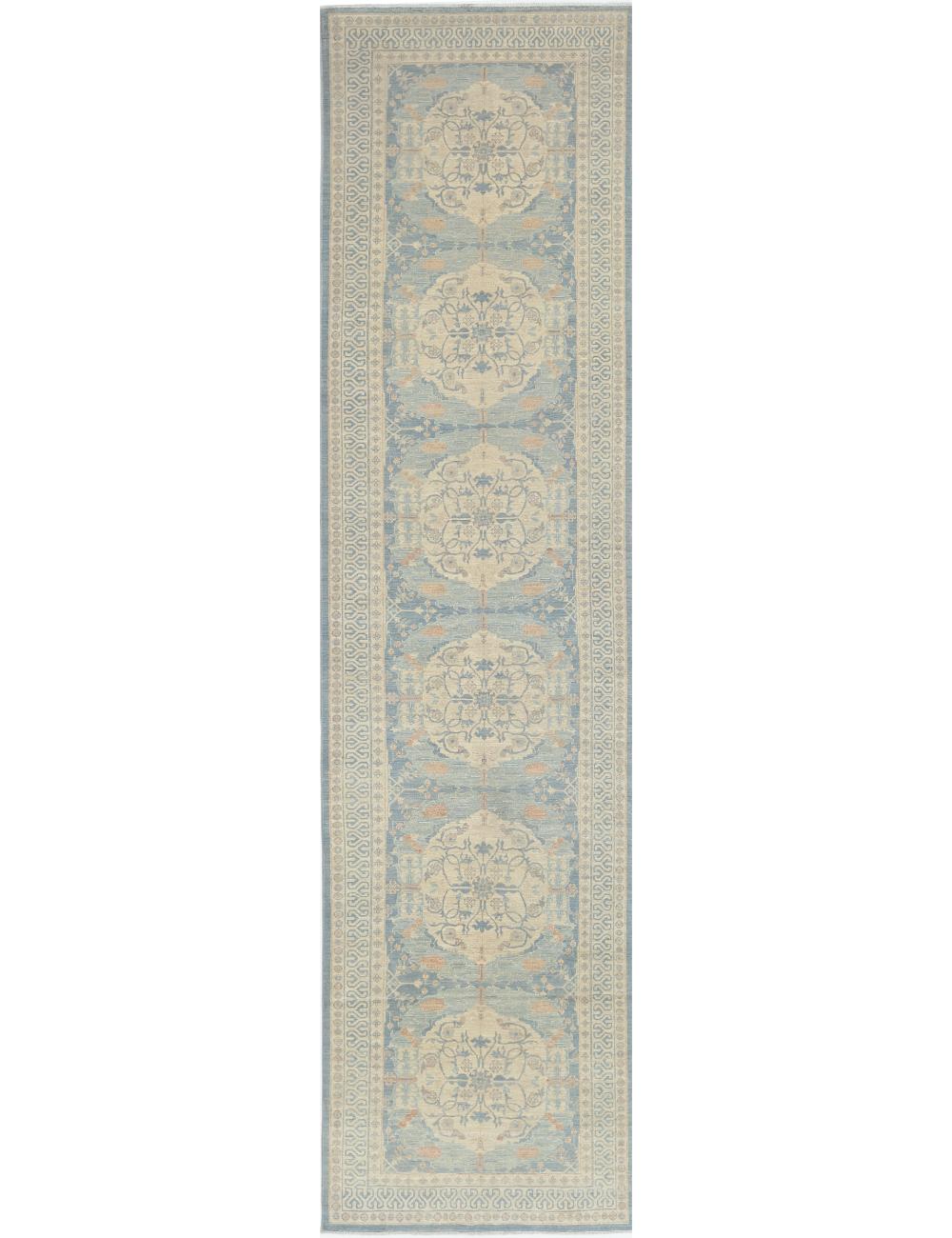 Choose a rug pad slightly smaller than your runner, typically 2 inches shorter and narrower on all sides, so the pad is not visible at the edges. For hardwood floors choose a felt-and-rubber pad that grips the floor without leaving adhesive residue. For stone and tile a rubber non-slip pad is appropriate. For carpet-over-carpet applications a thin waffle-grip pad prevents bunching without adding excessive height.
For staircases, purpose-made stair runner pads are available that accommodate the tread-and-riser format of staircase installation. These are an important addition to any staircase runner installation, both for safety and for protecting the runner from the friction of the stair nosing.
Browse our full collection of extra long runner rugs at ALRUG. For shorter runners see our standard runner rug collection. Every piece is 100% hand-knotted and ships free worldwide.
Frequently Asked Questions
How long should a hallway runner be?
Leave 4 to 6 inches of bare floor at each end of the runner and 4 to 6 inches on each side. For a hallway of 20 feet, a runner of 18 to 19 feet is ideal. For a hallway of 30 feet, look for a runner of 27 to 28 feet. Always measure your specific hallway rather than relying on standard assumptions.
How do I calculate the length for a staircase runner?
Add the tread depth and riser height of one step. Multiply by the number of steps. Add 12 to 18 inches for landings at top and bottom. For 20 steps with a 10 inch tread and 7 inch riser: 20 x 17 inches = 340 inches = 28.3 feet. Round up to 30 feet for installation room.
What is the widest extra long runner available?
Standard runner widths are 2'6" and 3'. For wider requirements, a narrow area rug in a 4x12 or 4x16 format may be more appropriate than a standard runner width. Contact us for specific requirements.
How long does it take to make a hand-knotted extra long runner?
A 3x20 foot hand-knotted runner contains approximately 750,000 individual knots at a moderate knot density of 100 knots per square inch. At a rate of 8,000 to 10,000 knots per day for a skilled weaver, production takes 75 to 95 working days, or approximately 4 to 5 months. This is why genuine hand-knotted extra long runners are significantly less common than machine-made alternatives.
Can I get a custom length extra long runner?
Contact us directly for custom length requirements. We work with weaving workshops in Afghanistan and Pakistan that can accommodate specific length requests. Custom orders typically require 4 to 6 months lead time.
Are hand-knotted runners suitable for high traffic hallways?
Yes. Genuine hand-knotted wool runners are among the most durable floor coverings available for high-traffic corridors. The natural lanolin in Afghan and Pakistani wool provides inherent stain resistance. The knot-by-knot construction is structurally stronger than tufted alternatives. With proper care and a quality rug pad, a hand-knotted wool runner will outlast multiple generations of machine-made alternatives.