


A Soumak rug is made differently from almost every other handmade rug you will encounter. There are no individual knots tied around warp threads as in a hand-knotted pile rug. There are no interlaced weft threads creating a reversible surface as in a kilim. In Soumak weaving, supplementary weft threads are wrapped around pairs of warp threads and looped back under one, row by row across the entire width of the rug, building the pattern through the direction and color of the wrapping rather than through knotting or interlacing.
The result is a textile that sits between a kilim and a pile rug, sharing qualities with both but identical to neither. The front surface has a distinctive raised, herringbone-like texture created by the wrapping direction of each weft. The reverse is characteristically shaggy with loose weft ends hanging free. Soumak rugs are firm, flat, and exceptionally strong, significantly more durable than kilims of comparable quality.
Where Do Soumak Rugs Come From?
The Soumak technique takes its name from the village of Shemakha in the Caucasus region, where the tradition has its deepest historical roots. Caucasian Soumak rugs from Azerbaijan, Armenia, and Dagestan produced some of the boldest and most collectible examples of the tradition. The technique spread along ancient trade routes to northern Persia, where Shahsavan tribal weavers developed their own distinctive Soumak vocabulary, and to Afghanistan and Pakistan where the tradition continues in active production today.
The Afghan and Pakistani Soumak rugs in our collection draw from this Central Asian tribal tradition, using bold geometric designs executed in quality Afghan wool in the characteristic Soumak weft-wrapping technique. Each piece is hand-woven by skilled artisans working from memory rather than paper patterns, which gives these rugs the slight design variation and human character that machine production cannot replicate.
Design and Pattern
Soumak designs are bold, geometric, and assertive. Large diamond medallions, hooked angular motifs, stylized animal figures, and interlocking geometric borders are the most common elements. The design vocabulary is tribal rather than formal, with strong primary color contrasts and compositions that fill the field completely without the breathing space of more refined city rug traditions.
The palette in Afghan Soumak rugs tends toward deep reds, rich indigo blues, warm ivory, and forest green, drawn from the same natural dye tradition that informs the broader Afghan weaving world. The weft-wrapping technique creates a slightly raised dimensional surface that catches light differently from kilims and pile rugs, giving Soumak designs a visual depth and tactile interest that rewards close examination.
Soumak Rugs in Modern Interiors
The flat, firm profile of a Soumak rug makes it particularly well suited to dining rooms, studies, and hallways where a low-profile rug is preferable to a deep pile. Chairs slide across Soumak surfaces easily without catching on pile fibers, which is a practical advantage in dining rooms that pile rugs cannot match.
The bold tribal geometry of a Soumak reads powerfully in contemporary interiors where the pattern provides visual energy and grounding without the formality of a Persian city rug. Layered over a larger neutral flatweave, a Soumak becomes the focal point of a living room composition. Displayed on a wall, its flat structure hangs cleanly and its bold design reads as genuine art.
Browse related styles including our kilim rugs and Afghan rugs collections. For pile rug alternatives with similar tribal character explore our Baluchi rugs and Kazak rugs. Free worldwide shipping on every order from ALRUG, sourcing directly from Afghan and Pakistani weavers since 1952.
Frequently Asked Questions
What is a Soumak rug? A Soumak rug is a handmade flatweave rug created using weft-wrapping rather than knotting or tapestry weaving. Supplementary weft threads are wrapped around pairs of warp threads across the width of the rug, building the pattern through the direction and color of the wrapping. The result is a firm, flat rug with a distinctive raised herringbone surface texture and a characteristic shaggy reverse where the weft ends hang free.
What is the difference between a Soumak and a kilim? Both are flatweave rugs with no pile but the construction is completely different. A kilim uses a slit-tapestry technique where colored wefts interlace with warps, producing a reversible surface. A Soumak uses weft-wrapping which creates a raised textured front and a shaggy reverse. Soumak rugs are significantly stronger and more durable than kilims of comparable quality.
Where do Soumak rugs come from? The Soumak technique originates from the Caucasus region, specifically the area around the village of Shemakha in present-day Azerbaijan. The tradition spread to northern Persia, Afghanistan, and Pakistan. The rugs in our collection are woven by Afghan tribal artisans continuing this Central Asian weaving tradition.
Are Soumak rugs durable? Yes. The weft-wrapping technique produces a very strong, tightly packed structure that is more durable than a kilim and suitable for regular use in most areas of the home. Soumak rugs handle moderate to heavy foot traffic well. For very high-traffic areas a hand-knotted pile rug will generally outlast a flatweave, but Soumak is the most durable flatweave option available.
How do I care for a Soumak rug? Vacuum regularly on low suction without a beater bar. Rotate every six months for even wear. Address spills immediately by blotting with a clean dry cloth, never rubbing. Use a quality rug pad underneath. Have professionally cleaned every two to three years by a specialist in handmade rugs. Store rolled rather than folded if not in use.
Here is our latest blog on Soumak Rugs
Last Updated: May 2026
Some rugs are made by tying knots. Some are made by interlocking wefts. Soumak rugs are made by wrapping, and that single difference in technique produces a textile unlike anything else in the handmade rug world. Sturdy, flat, textured, and visually bold, a Soumak rug sits in a category of its own, somewhere between a kilim and a pile carpet, sharing qualities with both but identical to neither.
What is a Soumak Rug?
Soumak refers primarily to a weaving technique rather than a place of origin, although the name derives from the village of Shemaka in the Caucasus region. In Soumak weaving, supplementary weft threads in contrasting colors are wrapped around pairs of warp threads and looped back under one, producing a slanted, herringbone-like surface pattern with a slightly raised, embroidery-like texture. The technique is repeated row by row across the entire length of the rug, creating a smooth, tightly packed face and a characteristically shaggy, loose reverse side where the unwrapped weft ends hang free.
This weft-wrapping method is one of the oldest textile techniques in the world. Evidence of weft-wrapping has been found in archaeological sites from the ancient Near East dating back thousands of years, making Soumak not just a beautiful weaving style but one of the most historically significant textile traditions on earth.
The result is a rug that is stronger and more durable than a kilim, which uses a simpler interlocking weft structure, but less thick underfoot than a hand-knotted pile carpet. Soumak rugs are firm, flat, and dense with a characteristic surface texture that catches the light differently from every angle.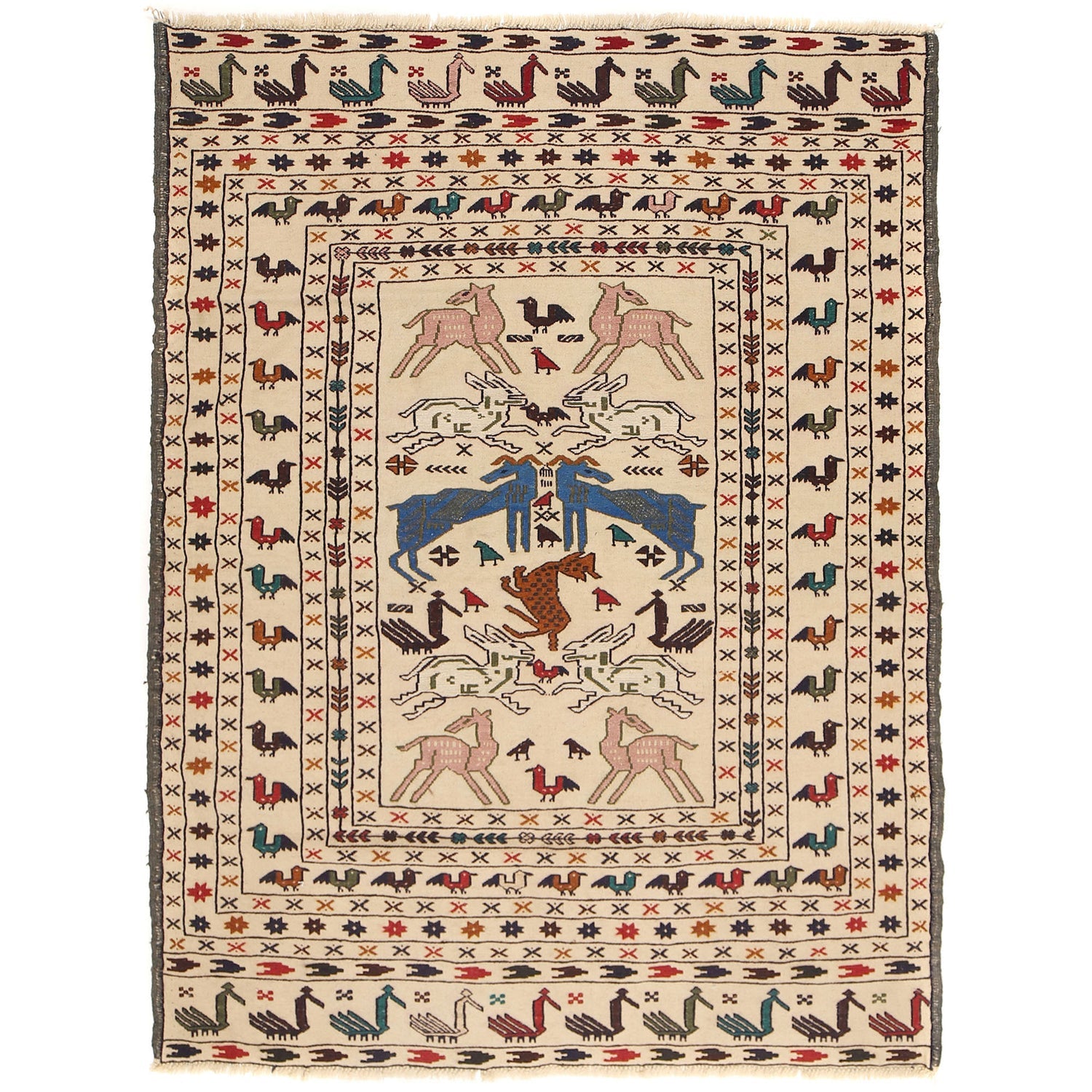
Where Do Soumak Rugs Come From?
Soumak weaving has its deepest roots in the Caucasus region, spanning present-day Azerbaijan, Armenia, Georgia, and Dagestan, where tribal and village weavers developed and passed down the technique across generations. In the Caucasus, Soumak weaving was used to produce large bold tribal carpets as well as practical domestic objects including saddlebags, storage bags, and bedding.
The technique spread widely along the Silk Road. In northern Persia, the Shahsavan tribes became particularly renowned for their intricately woven Soumak bags and floor coverings. Kurdish weavers in eastern Anatolia adopted and adapted the style into their own regional tradition. Soumak weaving is also found in Afghanistan, Pakistan, and parts of Central Asia, each region producing pieces with distinct character while sharing the same fundamental weft-wrapping structure.
Today Soumak rugs are woven in the Caucasus, Persia, Turkey, Afghanistan, Pakistan, and India. The finest antique pieces from the Caucasus and northern Persia are among the most collectible tribal textiles in the world.
How a Soumak Rug is Made
The Soumak weaving process begins with a set of vertical warp threads stretched across a loom. The weaver then works horizontally across the rug, wrapping colored weft threads over four warp threads and pulling them back under two in a continuous repeating motion. Each pass builds the pattern row by row. Unlike pile knotting, which ties individual knots and cuts them to create a raised pile, Soumak wrapping creates the pattern through the direction and color of the wrapped wefts themselves.
The process is slow and labor intensive. A single weaver works each row by hand, building the design from memory or from a simple sketch. The pattern only becomes fully visible from the front as the work progresses. Because each weft wrapping is interlocked with the structure of the rug, the finished piece is exceptionally strong and stable.
The reverse side of a Soumak rug is deliberately left unfinished, with loose weft ends hanging from the back. This is not a flaw but a characteristic of the technique. Running your hand across the back of a Soumak immediately distinguishes it from any other rug type.
Soumak vs Kilim
This is the most common source of confusion for buyers. Soumak and kilim are both flatweave rugs with no pile, and at a glance they can look similar. But the construction is completely different.
A kilim is woven using a tapestry technique where colored weft threads pass back and forth between warp threads to create the pattern. The front and back of a kilim look essentially the same.
A Soumak is woven using weft wrapping, which creates a slightly raised surface texture and a shaggy reverse. The front of a Soumak has a distinct embossed quality that kilims do not have. Soumak rugs are also significantly stronger and more durable than kilims of comparable quality.
Designs and Patterns
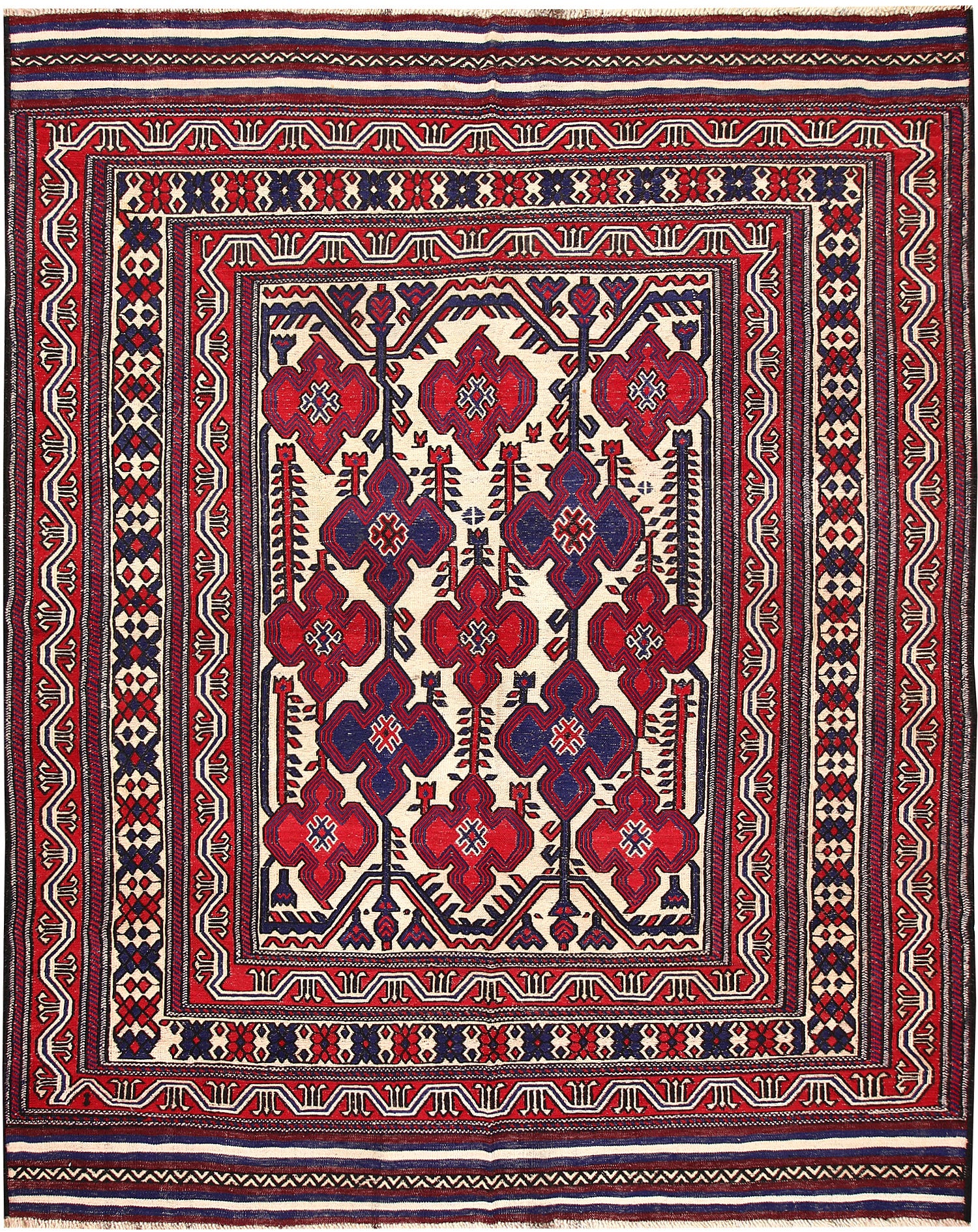
Soumak rugs are known for their bold, assertive geometric designs. Large diamond medallions, hooked angular motifs, stylized animal figures including dragons, birds, and horses, and interlocking geometric borders are the most common elements across the tradition. The Caucasian Soumak tradition in particular is famous for bold, powerful compositions where the entire field is filled with strong geometric figures leaving little empty space.
In Persian Soumak pieces, especially from the Shahsavan tradition, the designs are often more intricate and finely detailed, with smaller repeating motifs arranged in structured all-over fields. Afghan and Pakistani Soumak pieces tend toward bold tribal geometry similar to the Caucasian tradition.
The color palette varies by region. Caucasian pieces typically use deep reds, rich blues, ivory, and black. Persian tribal pieces lean toward warm earth tones, rich reds, and greens. Contemporary pieces produced for international markets are available in a much wider range including soft neutrals, faded pastels, and earthy naturals that work well in modern interiors.
How to Identify an Authentic Soumak Rug
Flip the rug over. The back of a genuine Soumak will show loose, hanging weft ends creating a characteristically shaggy reverse surface. This is the single most reliable authenticity test and cannot be convincingly replicated by machine production.
The front surface should have a slight raised texture, firmer and more dimensional than a kilim but without the soft pile of a knotted carpet. Run your hand across the face and you will feel the herringbone-like direction of the wrapped wefts.
The edges and ends of an authentic handmade Soumak will show the natural character of hand finishing, slightly irregular and individual. Machine-made imitations have perfectly uniform edges and a completely flat, lifeless surface on both sides.
How to Choose a Soumak Rug
Consider where the rug will be used. Soumak rugs are flat and firm underfoot, which makes them excellent for dining rooms, studies, and hallways where a low-profile rug is preferable. In living rooms and bedrooms where softness underfoot is a priority, a hand-knotted pile rug may suit better, though layering a Soumak over a larger neutral pile rug is an increasingly popular interior design approach.
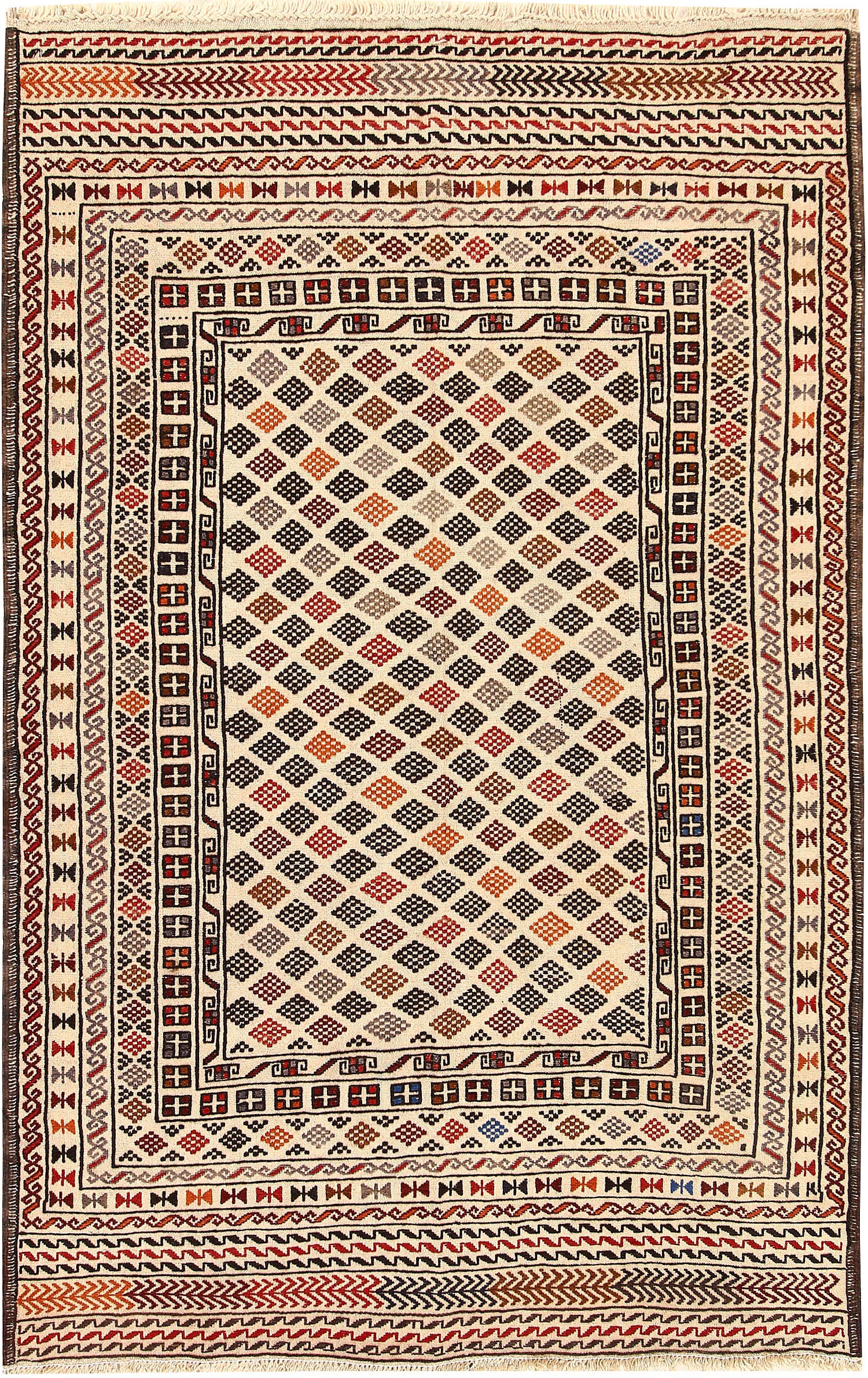
Consider the age and origin. Antique Caucasian and Persian Soumak rugs from the late 19th and early 20th centuries are the most collectible and will appreciate over time. Contemporary pieces from Afghanistan, Pakistan, and India offer the same visual character at more accessible prices and are a strong choice for everyday use.
Consider the design in relation to your space. The bold geometry of a Soumak needs room to breathe. In a smaller space, a piece with a cleaner, more restrained composition will be easier to live with. In a larger room, the full drama of a large Caucasian Soumak with a complex field and multiple borders is one of the most striking things you can put on a floor.
Frequently Asked Questions
What is the difference between a Soumak and a kilim? Both are flatweave rugs with no pile, but the construction is completely different. A kilim uses a tapestry interlocking weft technique producing a flat, reversible surface. A Soumak uses weft wrapping which creates a slightly raised, textured surface on the front and a shaggy, loose reverse. Soumak rugs are stronger and more durable than kilims.
Are Soumak rugs durable? Yes. The weft-wrapping technique produces a very strong, tightly packed structure that is more durable than a kilim and suitable for regular use in most areas of the home. For very high-traffic areas, a hand-knotted pile rug will generally last longer.
Where do the best Soumak rugs come from? Antique pieces from the Caucasus, particularly Azerbaijan and Dagestan, and from the Shahsavan tribal tradition of northern Persia are considered the finest. Contemporary Soumak production is centered in Afghanistan, Pakistan, and Turkey.
How do I know if a Soumak rug is authentic? Flip it over. An authentic handmade Soumak has a shaggy, loose reverse surface where the weft wrapping ends hang free. Machine-made imitations have a flat, uniform reverse with no loose ends. The front surface should also have a slight raised texture from the weft-wrapping direction.
Can a Soumak rug be used as a wall hanging? Yes, and it is an excellent use of a Soumak. The bold flat geometry reads very well displayed vertically and the firm, stable flatweave structure hangs cleanly without distorting. Use a wooden dowel or a rug hanging system through the top end for a clean gallery-style display.
How do I care for a Soumak rug? Vacuum regularly on low suction with no beater bar. Rotate every six months. Address spills immediately by blotting with a clean dry cloth, never rubbing. Have professionally cleaned every two to three years by a specialist in handmade rugs. Store rolled rather than folded if not in use.
You can explore our full range of handmade flatweave and pile rugs in our Afghan rugs, kilim rugs, and tribal rugs collections. For guidance on identifying genuine handmade construction see our post on how to tell if a rug is handmade. For care guidance see our complete rug care guide. All orders ship worldwide free of charge.
Browse our full Soumak rugs collection, hand-woven and sourced directly since 1952, with free worldwide shipping on every order. For related flatweave styles, see our Kilim rugs.
Learn more in our complete Soumak rugs guide covering history, weaving technique, and buying tips.


