


Baluchi Rugs: History, Patterns and Complete Buying Guide
Last Updated: May 2026
Baluchi rugs occupy a unique place in the world of hand-knotted textiles. They are tribal rugs in the truest sense - made not in commercial workshops but by Baluch weavers whose families have practiced the craft for generations, working from design vocabularies passed down through mothers and grandmothers rather than written patterns or professional designers. The result is a rug type that carries genuine cultural identity in every knot, with a visual character that is unmistakably its own.
For buyers who have discovered Baluchi rugs, they tend to become a passion. The dark, jewel-toned palette, the intricate geometric patterning, the prayer rug formats, the distinctive wool quality, and the relatively accessible price point compared to more commercially produced rug types all combine to make Baluchi rugs one of the most rewarding areas of the handmade rug market to explore. This guide covers everything you need to know before buying one.
Who Are the Baluch People
The Baluch - also spelled Balochi, Balouch, or Balochi depending on transliteration - are a semi-nomadic people whose traditional territories span a vast region including eastern Persia, southwestern Afghanistan, and western Pakistan. The Baluchistan region that bears their name is one of the largest and most sparsely populated areas in South Asia, a landscape of desert, mountain, and steppe that has shaped both the character of the people and the aesthetic of their textiles.
Baluch weavers are overwhelmingly women. In traditional Baluch society, weaving is a female art - girls learn at their mothers' sides from early childhood, absorbing not just the technical skills but the design traditions of their family and tribe. This transmission of knowledge from woman to woman across generations gives Baluchi rugs their distinctive character. Unlike commercially produced rugs woven to a designer's specification, a Baluchi rug reflects the aesthetic sensibility of the individual weaver working within the design tradition of her community.
The Baluch people are not a single unified group but a collection of related tribes and clans, each with their own weaving traditions and design preferences. This diversity is part of what makes the Baluchi rug category so rich - pieces from different communities, different regions, and different periods can look quite different from each other while still sharing the fundamental characteristics that define the Baluchi aesthetic.
Design Characteristics
The visual world of Baluchi rugs is defined by geometry and darkness. Where many Central Asian and Middle Eastern rug traditions favor rich reds and blues on relatively open fields, Baluchi rugs tend toward a darker, more complex palette and a denser, more intricate field layout.
The ground colors most associated with Baluchi rugs are deep midnight blue, dark aubergine, rich brown, and a characteristic dark red that reads almost as wine or plum rather than the brighter reds of a Bokhara or Afghan tribal rug. These dark grounds give Baluchi rugs a moody, sophisticated quality that works particularly well in low-light rooms and against dark wood furniture.
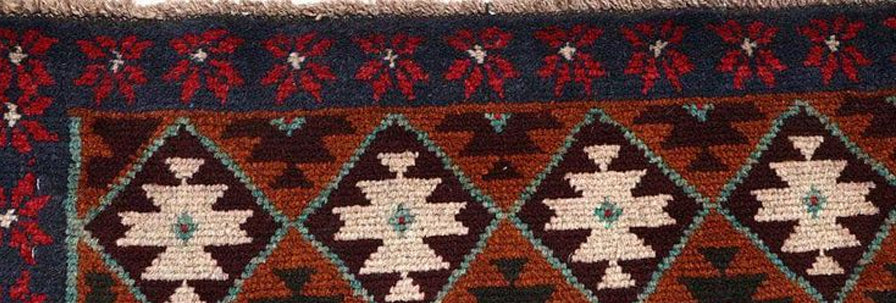
Against these dark grounds, the patterning is typically carried in ivory, camel, rust, and occasionally bright accents of orange or teal. The contrast between the dark field and the lighter patterning creates the visual impact that makes Baluchi rugs so distinctive at a distance, while the density and intricacy of the patterning rewards close inspection.
The design vocabulary of Baluchi rugs is primarily geometric. Repeating medallions, angular boteh motifs, highly stylized tree of life patterns, geometric rosettes, and interlocking diamond formations are among the most common field arrangements. Prayer rug formats - with a distinctive mihrab arch at one end of the field - are particularly associated with Baluchi weaving and some of the most collectible Baluchi pieces are prayer rugs of exceptional design quality.
Borders in Baluchi rugs are typically narrow relative to the field, often composed of multiple small geometric guard borders rather than a single wide main border. This gives the rug a busy, all-over quality where the eye is drawn into the pattern rather than being framed by it.
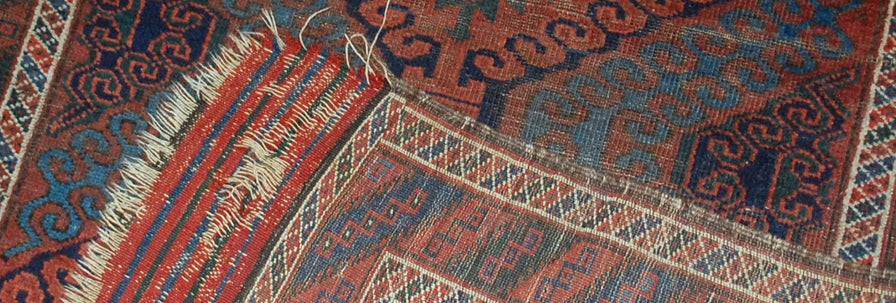
One of the most distinctive features of many Baluchi rugs is the use of a kilim or flat-woven skirt at each end of the rug, beyond the knotted pile field. These kilim ends are often woven in striped or geometric patterns that complement the pile field and are a reliable indicator of authentic tribal production.
Construction and Materials
Baluchi rugs are hand-knotted using wool pile on wool or cotton foundations. The wool used in traditional Baluchi production comes from the sheep breeds native to the Baluchistan region - a fiber that tends to be slightly coarser than the highland wools used in Afghan Khal Mohammadi or Pakistani Bokhara production, but that has its own distinctive quality. The slight coarseness of Baluchi wool gives the pile a characteristic texture that differs from the silkier feel of finer Afghan and Pakistani wools.
In the finest Baluchi pieces, the pile is supplemented with silk accents - small areas of the design worked in silk rather than wool to create a contrasting sheen effect. These silk highlights, often used in the most important motifs of the field or in the mihrab of a prayer rug, add considerable visual interest and are associated with higher-quality pieces.
The knot used in Baluchi production is typically the asymmetric Persian knot. Knot density varies considerably across the range - from relatively coarse village pieces in the 40-80 knots per square inch range to finer city-influenced work approaching 150 KPSI. The finest antique Baluchi prayer rugs can exceed this, though most pieces available in today's market fall in the middle of this range.
Natural dyes are associated with the finest and most collectible Baluchi rugs. The characteristic deep blues of the best pieces come from indigo, the reds from madder and other plant-based sources, and the browns and camels from undyed or minimally processed natural wools. Synthetic dyes entered Baluchi production in the late 19th and early 20th centuries and most contemporary Baluchi production uses synthetic dyes, though the better producers continue to work with natural dye traditions.
Baluchi Rugs vs Other Afghan and Pakistani Tribal Rugs
Buyers new to the Afghan and Pakistani rug market sometimes find it difficult to distinguish between the various tribal types. The key distinguishing characteristics of Baluchi rugs relative to their near neighbors are worth understanding.
Compared to Khal Mohammadi rugs, which feature a more regular, structured gul layout on a typically rich red ground, Baluchi rugs are generally darker in overall tone, more varied in their design arrangements, and more likely to feature the prayer rug format and the kilim end pieces described above. The Khal Mohammadi aesthetic is bolder and more immediately legible; the Baluchi aesthetic is more complex and layered.
Compared to Bokhara rugs, which share the gul medallion vocabulary but carry it in a more regular, symmetrical layout on a typically brighter red or navy ground, Baluchi rugs are denser and more intricate in their patterning and darker in their overall color character. The Bokhara format is more immediately accessible; the Baluchi requires more sustained looking.
Compared to Gabbeh rugs from the Qashqai tribal tradition, which favor bold, almost naive design elements on open fields, Baluchi rugs are far more detailed and geometrically complex. The Gabbeh aesthetic is immediate and playful; the Baluchi is intricate and meditative.
Antique and Vintage Baluchi Rugs
Baluchi rugs have a strong collector following, and for good reason. Antique Baluchi prayer rugs and main carpets from the late 19th and early 20th century - pieces made with natural dyes, fine wool, and the full traditional design vocabulary - are among the most desirable tribal rugs available on the market. Their relatively modest size compared to large palatial rugs from Tabriz or Isfahan makes them accessible to collectors who cannot accommodate or afford those larger pieces, while the quality of the finest examples is equal to anything the handmade rug world has to offer.
When considering an antique or vintage Baluchi rug, the condition of the pile, the quality of the natural dyes, and the integrity of the design are the primary quality indicators. Wear in antique pieces is acceptable and expected - a well-worn Baluchi with good color and a clear design is more desirable than a less-worn piece with poor dyes or a weak design. The kilim ends, if present and intact, add both authenticity and value.
How to Care for a Baluchi Rug
Care for a Baluchi rug follows the same principles as for any hand-knotted wool rug. Vacuum regularly using suction only, without a beater brush. Rotate every six to twelve months to distribute wear. Use a quality rug pad underneath to prevent slipping and protect the foundation.
For spills, blot immediately with a clean white cloth working from the outside inward. For deep cleaning, use a professional rug cleaner experienced in hand-knotted wool and tribal pieces. Given the natural dye content of finer Baluchi rugs, it is particularly important to use a cleaner who understands the different behavior of natural versus synthetic dyes under washing conditions.
Explore Our Collection
Our Baluchi rug collection is sourced directly from weavers in Afghanistan and Pakistan. You can also explore related tribal traditions in our Afghan rugs, Khal Mohammadi rugs, tribal rugs, and Bokhara rugs collections. For size guidance before purchasing, our living room rug size guide covers the most common placement questions. All orders ship worldwide free of charge, and our custom rug service can produce any Baluchi-inspired design in a specific size or colorway to your requirements.
Frequently Asked Questions
What is a Baluchi rug? A Baluchi rug is a hand-knotted tribal rug made by Baluch weavers from the Baluchistan region spanning eastern Persia, southwestern Afghanistan, and western Pakistan. They are characterized by dark jewel-toned color palettes, dense geometric patterning, and kilim flat-woven ends. They are among the most distinctive and collectible tribal rugs from the Afghan and Pakistani weaving tradition.
Where are Baluchi rugs made? Baluchi rugs are made across a broad region including the Baluchistan provinces of Afghanistan and Pakistan, as well as the Khorasan and Sistan-Baluchestan regions of eastern Persia. Different weaving communities within this region produce rugs with somewhat different design characteristics, though all share the fundamental Baluchi aesthetic vocabulary.
What makes Baluchi rugs different from other Afghan rugs? The most distinctive features of Baluchi rugs are their dark color palette - deep midnight blues, aubergines, and dark reds rather than the brighter reds of Bokhara or Khal Mohammadi rugs - their dense and intricate geometric patterning, the prayer rug format frequently used, and the characteristic kilim flat-woven ends beyond the pile field at each end of the rug.
Are Baluchi rugs good quality? Yes. Genuine hand-knotted Baluchi rugs made from quality wool with natural or good-quality synthetic dyes are durable, long-lasting pieces that improve with age. The finest antique Baluchi rugs are museum-quality objects. Contemporary Baluchi production varies in quality - as with any handmade rug, examining the pile density, wool quality, and dye quality before purchasing gives the most reliable indication of what you are buying.
What is a Baluchi prayer rug? A Baluchi prayer rug is a Baluchi rug woven in the prayer rug format, with a distinctive mihrab arch design at one end of the field. Prayer rugs are typically smaller than main carpets - usually in the 3x5 or 4x6 size range - and are among the most collectible and aesthetically refined pieces in the Baluchi weaving tradition. Many antique Baluchi prayer rugs feature silk highlights in the mihrab and field patterning.
How can I tell if a Baluchi rug is genuine? Look for the characteristic dark color palette, dense geometric field patterning, and kilim flat-woven ends. Turn the rug over and examine the back - a genuine hand-knotted Baluchi will show individual knots in a pattern mirroring the front. The pile should feel slightly textured rather than slippery, consistent with quality Baluchistan wool. For a complete guide to identifying genuine handmade rugs, see our post on how to tell if a rug is handmade.