


Jaldar Rugs: History, Patterns and Complete Buying Guide
Last Updated: May 2026
Among the many hand-knotted rug traditions that have emerged from Afghanistan and Pakistan over the centuries, the Jaldar stands apart for its visual distinctiveness. At first glance a Jaldar rug is unmistakable - the bold repetition of the gul motif across a richly colored field, the precise geometric patterning that speaks to a weaving tradition refined over generations, and the dense hand-knotted wool construction that gives these rugs their characteristic weight and depth. Once you know what a Jaldar rug looks like, you will recognize it immediately in any collection.
Yet despite their quality and distinctiveness, Jaldar rugs remain less well known than some of the more famous rug traditions from the same region. Buyers who discover them often become devoted collectors. This guide covers everything you need to know - where Jaldar rugs come from, what makes their design unique, how they are constructed, and how to choose one for your home.
What is a Jaldar Rug
The word Jaldar comes from the Persian and Dari roots for "pattern holder" or "design carrier" - a fitting name for a rug type defined above all by its structured, repeating decorative layout. Jaldar rugs are part of the broader Bokhara and Turkmen rug family, sharing the characteristic gul medallion format that defines weaving traditions across Afghanistan, Pakistan, and the historical Turkmen territories of Central Asia.
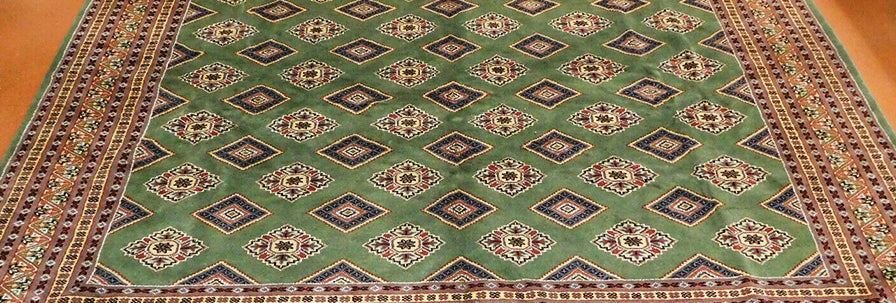
What distinguishes a Jaldar specifically is the way the field is organized. Where a classic Bokhara rug typically features rows of identical octagonal guls arranged in a straightforward grid across the field, a Jaldar rug introduces greater complexity and movement into the layout. The guls in a Jaldar are often arranged in a more dynamic, interlocking pattern. Secondary motifs fill the spaces between the primary guls, creating a denser, more layered visual field. The result is a rug that rewards close inspection - the more carefully you look, the more design detail reveals itself.
Origins and History
Jaldar rugs are woven primarily in the border regions between Afghanistan and Pakistan, in the same weaving communities that produce Bokhara, Khal Mohammadi, and other members of the Turkmen-influenced rug family. The weavers are largely from Turkmen and Afghan tribal communities whose ancestors carried weaving traditions westward from Central Asia over many centuries.
The gul motif at the heart of the Jaldar design is one of the oldest and most geographically widespread motifs in the history of rug weaving. In the Turkmen weaving tradition each tribe had its own distinctive gul - a heraldic design element that identified the tribe of origin and was passed down through generations of weavers. The specific gul arrangements seen in Jaldar rugs reflect this long tribal heritage, though the designs have evolved and blended over centuries of movement, trade, and cultural exchange across the region.
The weaving communities that produce Jaldar rugs today work primarily in and around Peshawar in Pakistan and in the Afghan provinces near the border. The craft is practiced in home workshops by weavers who learned from their parents and grandparents, maintaining a continuity of technique and design vocabulary that connects the rugs being made today to those produced generations before them.
Design Characteristics
The most recognizable feature of a Jaldar rug is its field layout. The primary design element is the gul - a geometric medallion typically octagonal or diamond-shaped - which is repeated across the field in structured rows. In a Jaldar, these guls are often larger and more elaborately detailed than in a standard Bokhara, and the spaces between them are filled with smaller secondary motifs rather than left as open field.
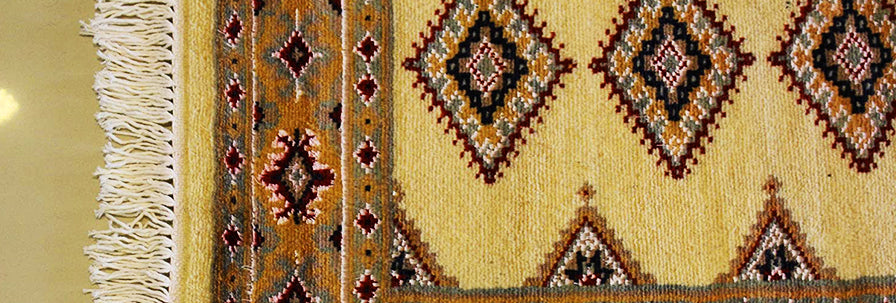
The border system of a Jaldar rug is typically composed of multiple guard borders framing a wider main border, all carrying their own geometric patterning that complements the field design without competing with it. The interplay between the busy field and the structured border creates a visual balance that is one of the hallmarks of the finest examples.
Color is an important differentiator within the Jaldar family. The most traditional and most frequently seen colorway uses deep burgundy or madder red as the ground color, with ivory, navy, and dark green as secondary colors in the gul patterning. This combination gives traditional Jaldar rugs a rich, jewel-like quality that works well in formal rooms and against dark wood furniture. More contemporary Jaldar rugs are also produced in navy blue grounds, ivory grounds, and in the washed-out softer palette of the Ziegler or Chobi tradition - these pieces suit modern and transitional interiors and have grown significantly in demand.
The pile direction in a Jaldar rug produces a characteristic sheen effect. When you look at the rug with the pile running toward you, the colors appear darker and deeper. When you view it against the pile, the colors lighten and the pattern takes on a more silvery quality. This optical effect is one of the pleasures of a dense hand-knotted wool rug and something photographs rarely capture fully.
Construction and Quality
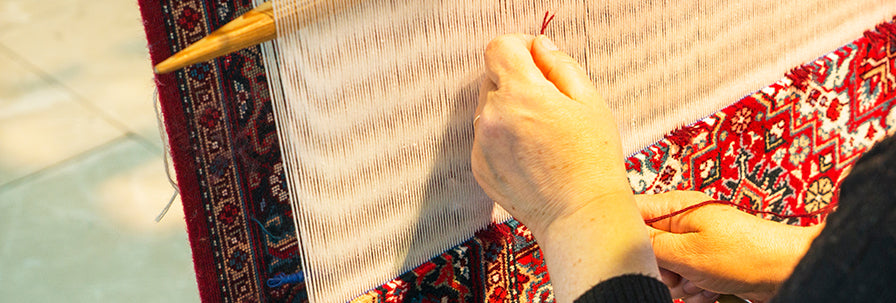
Jaldar rugs are hand-knotted on cotton or wool foundations using high-quality wool pile. The wool used in the finest examples comes from the same highland sheep breeds that have supplied the great rug-weaving regions of Afghanistan and Pakistan for centuries - a dense, lustrous fiber that holds dye well and develops a characteristic sheen with age and use.
The knot used in Jaldar production is typically the asymmetric Persian knot, which allows greater design flexibility and finer detail than the symmetric Turkish knot used in some other traditions. The knot density in a quality Jaldar rug typically falls in the range of 80 to 150 knots per square inch - sufficient for the bold geometric patterning that defines the style without the extreme fineness required for pictorial or highly detailed floral designs.
The finishing process matters significantly in a Jaldar rug. After weaving, the rug is washed, dried flat, and clipped to an even pile height. The washing process softens the wool, sets the dyes, and begins the process of bringing out the natural sheen of the fiber. A properly finished Jaldar rug will have an even, well-clipped pile that shows the pattern clearly and feels substantial underfoot.
How a Jaldar Rug Performs in a Home
Jaldar rugs are practical as well as beautiful. The dense hand-knotted wool construction handles foot traffic well - wool fiber has a natural resilience that allows the pile to spring back after compression, maintaining its appearance over years of use in a way that synthetic pile cannot replicate. The natural lanolin in high-quality Afghan and Pakistani wool also provides some degree of natural resistance to soiling, making routine maintenance straightforward.
In terms of placement, Jaldar rugs work in most living spaces. The traditional deep red colorway suits formal living rooms, dining rooms, studies, and any space with traditional or transitional decor. The more contemporary ivory and washed-palette versions have proven equally at home in modern interiors where a geometric tribal rug provides textural and visual contrast to cleaner architectural lines.
A Jaldar rug in a standard 8x10 or 9x12 size is a substantial piece that anchors a room confidently. The bold geometric field creates a strong visual foundation without requiring the furniture arrangement to conform to it in the way a more delicate floral design might. Smaller Jaldar pieces in 5x8 or accent sizes work well as layering pieces or as focal points in smaller rooms.
Caring for a Jaldar Rug
The care requirements for a Jaldar rug are the same as for any high-quality hand-knotted wool rug. Vacuum regularly using suction only - avoid beater brushes or rotating heads that stress the pile over time. Rotate the rug every six to twelve months to distribute any foot traffic wear evenly across the surface. Use a quality rug pad underneath to prevent slipping and to cushion the rug from hard floor surfaces.
For spills, blot immediately with a clean white cloth, working from the outside of the spill inward to prevent spreading. Do not rub. For deep cleaning, use a professional rug cleaner with experience in hand-knotted wool. The investment in occasional professional cleaning is minor compared to the value and lifespan of the rug.
With proper care, a quality Jaldar rug will last decades and improve with age. The wool pile develops a natural patina over time, the colors soften and deepen, and the rug acquires the slightly antique quality that collectors and interior designers seek in genuinely old pieces. Many Jaldar rugs purchased today will still be in active use - and looking better for their age - fifty years from now.
How to Choose a Jaldar Rug
When selecting a Jaldar rug, the most important factors to assess are pile density, wool quality, and the clarity of the pattern.
Examine the back of the rug. The individual knots should be clearly visible and the pattern on the back should closely mirror the pattern on the front. A dense, well-knotted back indicates quality construction. A loose or uneven knot structure suggests lower quality.
Part the pile with your fingers and look at the base. The pile should be dense and firmly rooted in the foundation. If the pile parts easily to reveal a sparse, thin base, the rug has a low knot count and will wear faster.
Look at the wool quality. High-quality Afghan and Pakistani wool has a natural sheen that is visible even in an unlit room. It feels slightly warm and slightly grippy to the touch - not slippery like synthetic fiber or coarse like low-grade wool. Dull, flat-looking pile that feels soft and limp is often a sign of lower-grade wool or cotton pile presented as wool.
Check the evenness of the pile clipping. The surface of a well-finished Jaldar should be even across the entire rug, with no areas of noticeably longer or shorter pile except at the border transitions where a slight height variation is intentional. Uneven clipping indicates a lower standard of finishing.

Finally, assess the color. The dyes in a quality Jaldar rug should be rich, even, and consistent across each color area. Slight tonal variation - abrash - is a sign of genuine hand-dyeing and is desirable. Blotchy or inconsistent color within a single design area is a sign of poor dyeing practice.
Browse Our Jaldar Rug Collection
Our Jaldar rugs are sourced directly from weaving workshops in Afghanistan and Pakistan, with no middlemen between the weavers and your door. Every piece is hand-knotted using high-quality wool pile on a cotton foundation, finished to a consistent standard, and shipped worldwide free of charge.
You can explore our full range of Afghan rugs and Pakistani rugs alongside our Jaldar selection. Related styles worth exploring include Khal Mohammadi rugs, Bokhara rugs, and tribal rugs - all from the same weaving tradition and all available in a wide range of sizes. If you need a Jaldar rug in a specific size or colorway not available in our current stock, our custom rug service can produce one to your exact specifications.
Frequently Asked Questions
What is a Jaldar rug? A Jaldar rug is a hand-knotted rug from the Afghan and Pakistani weaving tradition, characterized by its structured repeating gul medallion layout and rich geometric patterning. The word Jaldar relates to "pattern carrier" in Persian and Dari, reflecting the design-forward character of these rugs. They are part of the broader Bokhara and Turkmen rug family and are woven primarily in communities along the Afghan-Pakistani border.
Where are Jaldar rugs made? Jaldar rugs are made primarily in weaving communities in Afghanistan and in the Peshawar region of Pakistan. The weavers are largely from Turkmen and Afghan tribal backgrounds whose families have practiced the craft for generations. The rugs are hand-knotted in home workshops using techniques and design vocabularies passed down through families.
What is the difference between a Jaldar rug and a Bokhara rug? Both Jaldar and Bokhara rugs belong to the same Turkmen-influenced rug family and share the gul medallion design vocabulary. The primary difference is in the field layout. A classic Bokhara rug arranges guls in simple uniform rows across the field. A Jaldar introduces more complexity - the guls are often larger and more detailed, secondary motifs fill the spaces between them more densely, and the overall layout has more visual movement and layering.
How long does a Jaldar rug last? A genuine hand-knotted Jaldar rug made from high-quality Afghan or Pakistani wool will last decades with proper care - often fifty years or more. The dense hand-knotted construction is inherently durable and the wool pile develops a natural patina with age that makes older pieces more beautiful rather than less. Many Jaldar rugs are passed down through generations as family heirlooms.
Are Jaldar rugs easy to clean? Yes, relative to other rug types. The natural lanolin in quality Afghan and Pakistani wool provides some resistance to soiling. Routine vacuuming with suction only keeps the pile clean and free of dust. Spills should be blotted immediately rather than rubbed. For deep cleaning, professional rug cleaning is recommended. Avoid machine washing or home steam cleaning, which can damage the wool pile and the foundation.
What colors do Jaldar rugs come in? The most traditional Jaldar colorway uses deep burgundy or madder red as the ground color with ivory, navy, and dark green in the gul patterning. Navy blue ground versions are also common in the traditional range. More contemporary pieces are produced in washed-out ivory and beige palettes that suit modern and transitional interiors. The full color range across the Jaldar family is broad enough to suit most decorating schemes.
What size Jaldar rug should I buy for a living room? An 8x10 or 9x12 Jaldar rug works well in most standard living rooms. The 8x10 suits rooms up to approximately 14x18 feet and accommodates most standard sofa configurations with the front legs on the rug. The 9x12 is better suited to larger rooms or arrangements where you want all four legs of the main furniture pieces on the rug. For specific guidance on sizing, see our complete rug size guide for living rooms.